Article · Regulation
The train, the pub and the chatbot: ICAEW on AI and client confidentiality
ICAEW says confidentiality duties still apply when staff use AI. What its November 2026 article expects from practices, and what's reportable.
By Stuart Kinsey, Co-founder of SimpleKPI4 min read

Most accountants remember the confidentiality talk from their training. Don't discuss a client's tax affairs in a train carriage. Don't leave a document out on the bar at after-work drinks.
On 9 November, ICAEW added a third place to that list.
In AI and client data: complying with the principle of confidentiality, Carrie Langridge and Sarah Brook, from the regulation team at ICAEW (the Institute of Chartered Accountants in England and Wales), say the "social environment" in the Code of Ethics now covers AI tools too. "A social environment has traditionally been the train or pub scenario, but we all know it can now be the online environment as well," says Sarah.
The short answer: Your confidentiality duties don't change when someone opens an AI tool. ICAEW expects a policy, staff training and regular reviews. And a breach of your own AI policy isn't automatically something you report to ICAEW.
What ICAEW has seen
ICAEW says it's seeing firms or members put confidential information into public AI tools without realising how many people it then reaches.
Its example: an accountant checking the tax treatment for a client selling some shares types the client's name and plans into a public AI tool.
"It's pretty much like putting it on a virtual notice board; other people now have access to that sensitive information," says Carrie.
Typing into a chat box can feel as private as your own laptop. If the tool isn't in a secure environment, Sarah says, it can be closer to posting publicly.
What ICAEW expects from firms
"We expect firms to have policies addressing the use of generative AI, including the potential risks to confidentiality," says Sarah.
The article accepts that firms can't control every individual action. What they can show is reasonable steps: clear policies, communicated well and backed by training. With AI changing so quickly, it calls regular reviews essential. Even firms with their own ring-fenced AI still face staff using public tools, or AI features inside other software, against policy.
The less-known part: what you report to ICAEW
"It's not necessarily the case that if you identify that someone has used AI against firm policy, then it should be reported to us," says Carrie. "Firms have policies on all sorts of things, and unless an internal policy breach also involves an identifiable breach of the Code of Ethics, it isn't reportable to ICAEW."
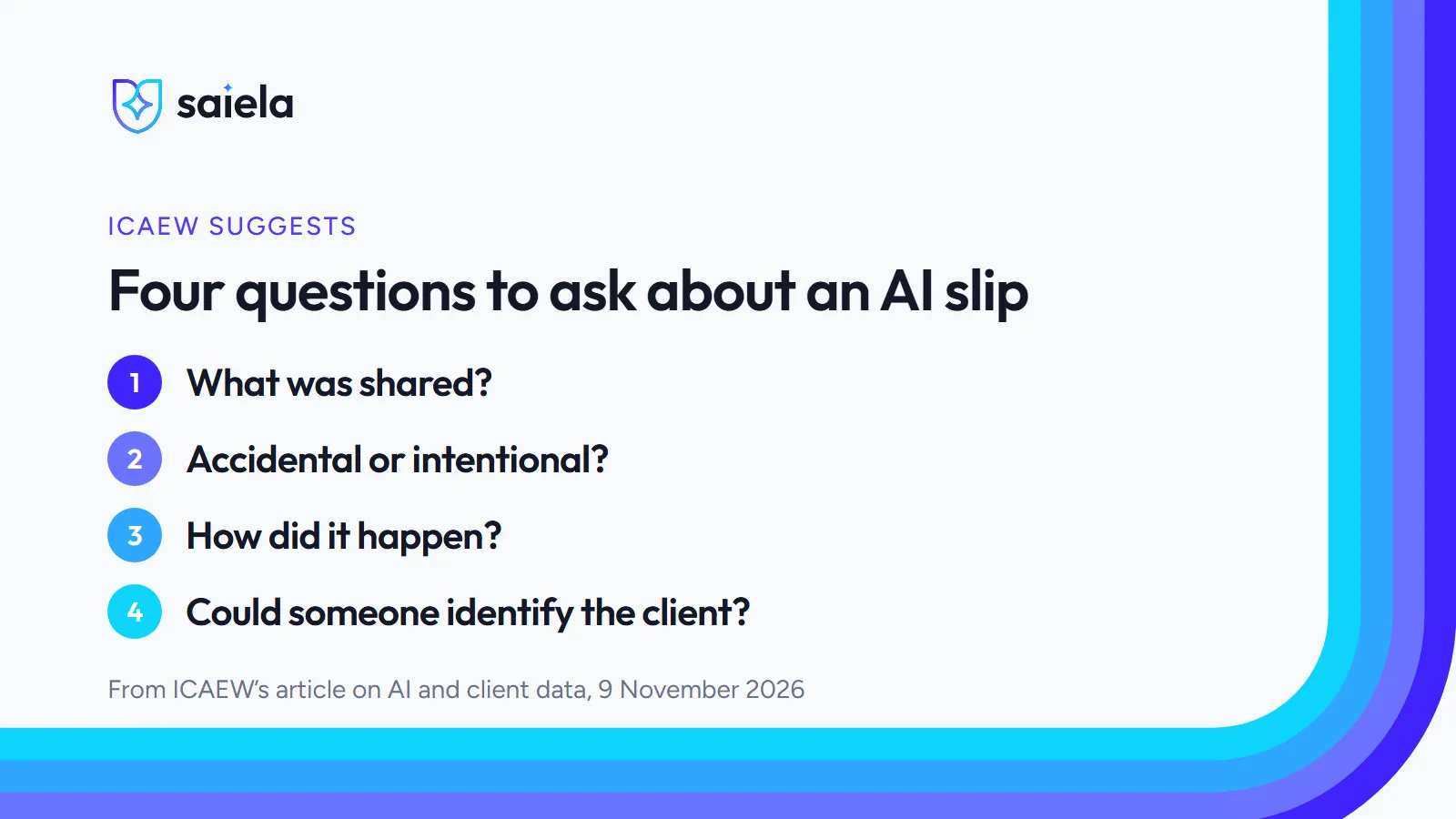
The test is whether the Code's confidentiality principle may have been breached. ICAEW suggests looking at what was shared, whether it was accidental or intentional, how it happened, and whether someone could identify the client from it.
Two other duties sit alongside: telling clients, and data protection law. Under Article 33 of the UK GDPR, a personal data breach is reported to the Information Commission (ICO) without undue delay and, where feasible, within 72 hours of becoming aware of it, unless it's unlikely to result in a risk to people.
What a practice can do
- Write it down. A short AI policy that names the approved tools and plans, and what mustn't go into them. Our free AI policy template has a section for accountancy practices, and free vs business AI plans helps with the approved list.
- Train people on real examples. ICAEW's share sale works well. Record who's done it.
- Know which tools are actually in use. An approved list only helps if you can see what people actually use. See shadow AI in small firms.
- Put a review date on the policy. New tools and new AI features will keep arriving.
- Agree how you'll look at a slip. ICAEW's questions above make a ready checklist.
On the data protection side: can staff put client data into ChatGPT? and what the ICO expects when your team uses AI.
Where we fit
Saiela helps with step three, and with keeping client details out of prompts. It works in the browser with ChatGPT, Microsoft Copilot, Claude, Gemini and Perplexity. You can allow or block each AI tool, and it spots other AI tools when your team starts using them, so you can review them.
Names, UTRs, NI numbers and other details are swapped for placeholders before a prompt is sent, then put back in the answer on your screen. The check happens on the person's own computer, so we never see the prompts. Staff AI lessons come with a record of who's done them.
If you'd like to see how that works in a practice, have a look at Saiela for accountants.
Sources
- ICAEW, AI and client data: complying with the principle of confidentiality, Regulation & Conduct, 9 November 2026. Checked 16 November 2026. Quotes are word for word from the article.
- UK GDPR, Article 33 (telling the regulator about a personal data breach). Checked 16 November 2026.
General information, not legal advice.

